
Where to Start With AI Agents: The MAPPED Framework
The reason most AI agent projects stall has nothing to do with the technology. It is a process mapping problem. Here is the framework we use at Advancer to fix it.
Most business owners know they want to use AI agents. Very few know where to start. That is not a knowledge gap, it is a process mapping gap, and from what I have seen it is the single biggest reason AI projects stall before they deliver any real return.
I meet these owners constantly. Not just here in Brisbane and across Australian SMEs, but the same conversation played out with the founders and operators I met recently at SuperAI in Singapore. Different markets, same problem. Everyone can see that AI agents are useful. Almost no one has a clear way to decide which agent to build first or whether a task should be an agent at all.
That decision is the whole game. Get it right and your first agent pays for itself and builds internal belief. Get it wrong and you end up with a half-finished pilot that quietly gets shelved. MAPPED is the six-step Advancer framework we run to get it right.
MAPPED stands for Map, Assess, Plan, Prepare, Experiment, Deploy
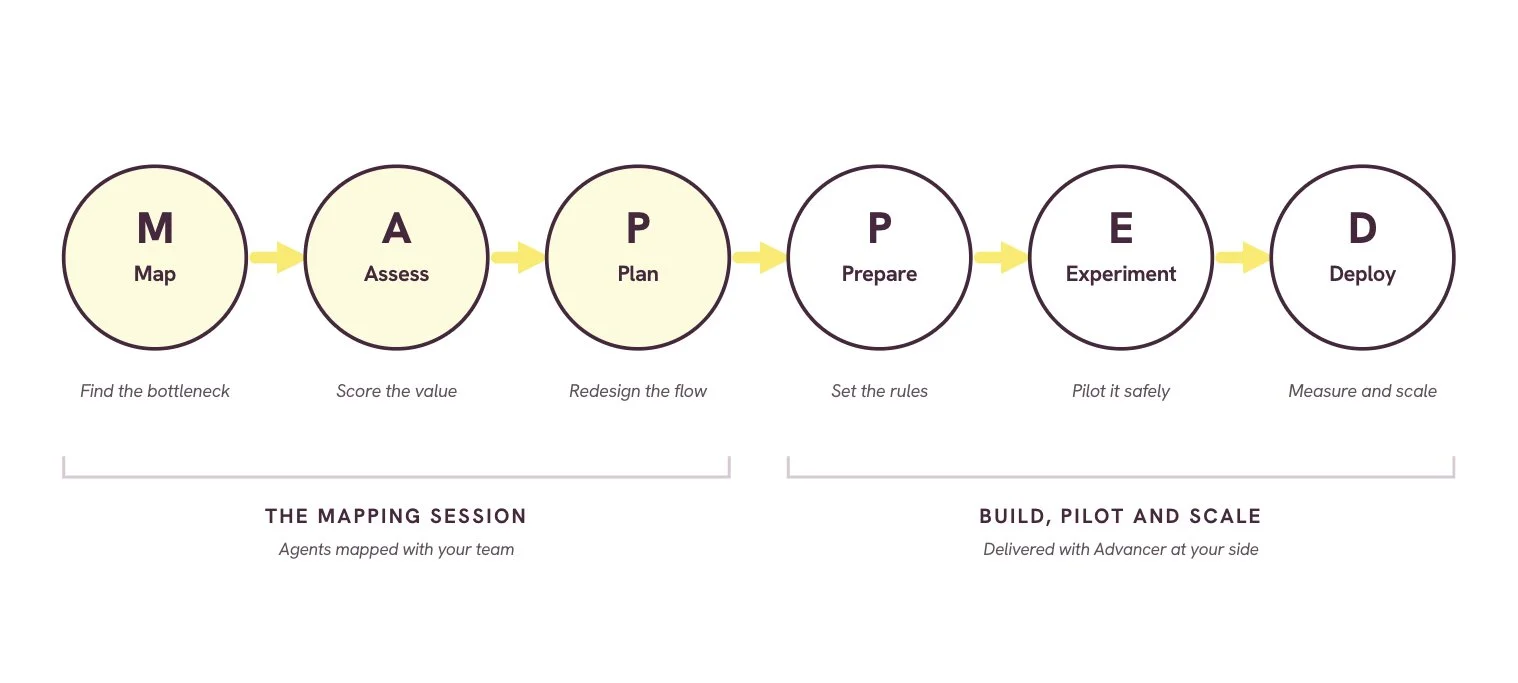
It is deliberately simple and the point is not to sound clever, it is to give a business a repeatable way to go from "we want to use AI" to a working agent that actually saves time or money. Here is how each step of MAPPED works.
Map: walk one process end-to-end
Before you build anything, pick one business process and walk it end-to-end. Follow the work from the moment it starts to the moment it is finished, step by step, exactly as it happens now.
Somewhere in that walk you will find the step everyone groans about. It is the point where work piles up, gets done late or gets quietly skipped when things get busy. That bottleneck is almost always where your first AI agent lives. You do not need to map the whole business. You need to map one process properly and be honest about where it hurts.
Assess: score it on value and feasibility
Once you have found the bottleneck, do not build yet. Score it on two things.
The first is value. How often does this step happen, and what does it cost you in time or money each time it runs? A painful task that only happens twice a year is not where you start. A moderately annoying task that happens 50 times a day usually is.
The second is feasibility. Are the rules clear enough to hand to an agent? Are the inputs structured, or are they scattered across email, notes and someone's head? Can you actually connect to the data the agent needs?
Score high on both and build it first. Score low on both and shelve it. The tasks in the middle need a judgement call and that is exactly where having a framework beats going on gut feel.
Plan: decide what you build first and what good looks like
Assessment gives you a shortlist. Planning turns it into a decision. Pick the one agent that scores highest on value and feasibility and commit to it as your first build. Resist the urge to do three at once. One working agent teaches you more than three unfinished ones.
Then define what success looks like before you start. If the agent is meant to cut the time spent on a task, write down the current time and the target. If it is meant to clear a backlog, decide what "cleared" means. Without a number, you cannot tell later whether the agent worked, and "it feels faster" is not a result you can build a business case on.
Prepare: get the data, rules and access ready first
Most agents that fail do not fail on the AI. They fail because the groundwork was not done. Preparation is where you sort that out before a single line of the agent is built.
That means writing down the rules the agent will follow, tidying up the inputs so they are consistent and confirming you have the access and permissions to connect to the systems the agent needs. It is unglamorous work. It is also the difference between an agent that runs reliably and one that breaks the first time it meets a real-world edge case.
Experiment: build small and test against real work
Now you build, and you build small. The goal of the experiment stage is not a finished product, it is proof. Stand up a working version of the agent and run it against real examples from the process you mapped.
Watch where it gets things right and where it gets things wrong. Real work is messier than any test case you would invent, so use real work. This is the stage where you learn what the agent can genuinely handle and where a human still needs to stay in the loop. Cheap to change now, expensive to change later.
Deploy: put it into the workflow and measure
Deployment is where the agent stops being a project and becomes part of how the business runs. Put it into the actual workflow, alongside the people who do the job, and measure it against the success number you set back in the planning stage.
Then keep watching. An agent is not a set-and-forget purchase. Processes change, inputs change and the agent needs to be checked and adjusted. Deploy well and you have your first real AI outcome, plus a team that has seen it work and is ready for the next one.
Not every task should be an AI agent
This is the part most people skip and it is the most important. Knowing what not to build is what saves you from the half-finished pilots. If a task scores low on value, low on feasibility or both, the right answer is to leave it alone. An AI agent is a tool, not a trophy. The discipline to say no to the wrong tasks is what makes the yeses pay off.
That is the whole logic of MAPPED. Find the real bottleneck, score it honestly, build the one that earns its place, prove it on real work then put it to work and measure it. It is not complicated. It just needs to be done in order.
We have run this framework across a lot of businesses now and the pattern holds every time. The companies getting value from AI agents are not the ones with the biggest budgets or the fanciest tools. They are the ones who mapped their process first.
If you know you should be using AI agents but you are not sure where yours should live, that is the exact problem MAPPED is built to solve.
Book a discovery call with the Advancer team and we will walk one of your processes with you.